
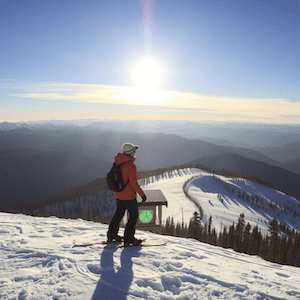
You are standing at 3,180 meters above sea level, and the wind carries a silence you cannot find in the Alps anymore. The air bites crisp and clean against your cheeks, carrying the faint smell of pine and woodsmoke from the valley below. In front of you, 25 kilometers of pristine groomed trails cut through the Trans-Ili Alatau mountains, and the sun hangs bright in a sky so intensely blue it feels manufactured. This is not Zermatt. This is not Aspen. This is Shymbulak, just 30 minutes south of Almaty, Kazakhstan, and it is exactly where your next ski trip needs to happen before the rest of the world discovers the lift lines.
Here is the thing about skiing in the Almaty Region that the brochures never fully capture. You get modern gondolas and heated chairlifts that rival anything in Austria, but you do not get the entitlement or the $30 bowls of chili. Instead, you get panoramic cafés perched on ridgelines serving hot beshbarmak and strong Kazakh tea after a thigh-burning descent, while local families laugh and share stories at wooden tables next to you. The resorts here are not simply maintaining old infrastructure. They are actively constructing the Almaty Mountain Cluster, an ambitious integrated all-season tourism corridor that will link existing resorts with virgin ski terrain around Kok-Zhailau Gorge and Kumbel Peak. By the end of 2029, this network promises approximately 250 kilometers of fully interconnected ski trails serviced by at least two 4-kilometer-long gondola lines.
Shymbulak: The Crown Jewel at 3,180 Meters
Shymbulak is the name you need to memorize before you book your flight. Established in the 1950s as a humble Soviet training facility, it has evolved into Central Asia’s undisputed giant of winter sports. You will find 10 lifts here, including state-of-the-art gondolas that whisk you from the valley floor to the snow line in minutes, covering a vertical drop that maxes out the region’s altitude at 3,180 meters. The resort offers six main slopes, carefully balanced with three easy cruisers and three genuinely advanced runs, spanning a total slope length of 37 kilometers that includes one of the longest continuous descents in Central Asia at roughly 2 kilometers.
When the sun dips behind the jagged peaks, Shymbulak transforms entirely. Night skiing happens on floodlit runs that glow amber against the snow, and the après-ski scene explodes into life with chic lounges and panoramic cafés where the atmosphere is, by all accounts, legendary. You will rub shoulders with Kazakh entrepreneurs, Russian professionals, and a growing contingent of Europeans who have already figured out the secret.
Ak-Bulak: High-Altitude Adventure East of the City
But variety matters when you are planning a week-long trip, and Shymbulak is only the beginning. Drive exactly 50 kilometers east of Almaty toward Talgar, winding through the foothills of the Trans-Ili Alatau, and you arrive at Ak-Bulak. This is high-altitude skiing in the rawest, most exhilarating sense, perched in a zone where the mountains feel bigger and the crowds feel pleasantly microscopic. You are looking at a vertical drop of around 400 meters packed into intense, challenging terrain that keeps your quads burning and your adrenaline pumping.
The infrastructure here includes two drag lifts and a chairlift that access seriously steep pitches, plus a toboggan run for when you want to trade your skis for a wooden sled and scream like you did when you were twelve years old. Facilities extend beyond pure alpine skiing into paragliding and backcountry sledding, so if your legs turn to jelly after lunch, you still have ways to get your fix of mountain air without requiring another climb to the summit.
Oi-Qaragai: The Boutique Alpine Escape Near Almaty
Oi-Qaragai offers a completely different rhythm from the high-altitude intensity of Shymbulak and Ak-Bulak. Located roughly 30 kilometers from Almaty, this resort sits in a scenic valley surrounded by pine forests and rolling mountain ridges, creating an atmosphere that feels more like a private alpine retreat than a traditional ski hub.
The vertical drop reaches around 600 meters, accessed by modern gondolas and chairlifts that glide quietly above snow-covered forests, delivering you to wide, flowing runs designed for long, comfortable descents. The terrain here favors intermediate skiers and families, with broad groomed slopes that encourage carving rather than survival skiing, though steeper sections and off-piste pockets still offer enough challenge for experienced riders.
Total slope length continues to expand as the resort develops, and what Oi-Qaragai lacks in sheer size, it compensates for with space, calm, and scenery that feels almost cinematic. When the lifts close, the experience shifts into something more relaxed and curated. Wooden lodges light up against the snow, restaurants serve hearty Central Asian cuisine, and panoramic terraces offer sweeping views across the Trans-Ili Alatau. Beyond skiing, visitors can explore snow tubing, horseback riding, zip lines, and traditional yurt stays, turning Oi-Qaragai into more than just a ski stop. It is the resort you choose when you want winter sports wrapped in comfort, quiet, and a surprisingly polished mountain experience.
The Future is Now: Almaty SuperSki and the 2026 Vision
The Almaty SuperSki concept is not marketing fluff dreamed up by consultants. It is concrete and steel pouring out of the ground right now. The government is expanding these resorts with the kind of capital that signals long-term commitment to tourism. We are talking about new gondola lines stretching four kilometers each, cutting through the Kok-Zhailau Gorge to physically link Shymbulak with Oi-Qaragai and emerging ski areas around Kumbel Peak.
When the AMC project reaches completion at the end of 2029, the region transforms from a collection of excellent but separate resorts into a unified ski circuit of approximately 250 kilometers. You are reading this in April 2026. That timeline means the full integration is just a few years away, with the first trails ready for next season.
When to Go and How to Save
Let us get practical for a moment, because logistics make or break a ski vacation. From downtown Almaty, you can reach Shymbulak, Oi-Qaragai, or Ak-Bulak in less than an hour on good roads. That proximity changes the equation entirely. You can sleep in a real city with opera houses, Soviet architecture, and restaurants serving proper laghman noodles, then ski world-class terrain by mid-morning without staying in some overpriced, isolated mountain village where your only dinner option costs a fortune. Your wallet will thank you for the geography. Winter airfares to Almaty consistently run 30 to 50 percent cheaper than the peak summer hiking season, which is the inverse of most ski destinations. Compare that to flying into Geneva or Salt Lake City in February, where you practically need a second mortgage just for the flight. The math starts to make uncomfortable sense.
You have a choice this coming winter. You can join the endless queues in Colorado or the packed tram lines in Chamonix, fighting for space on slopes that cost a fortune to reach and feel like shopping malls on snow. Or you can stand at the top of Shymbulak at 3,180 meters, looking out over the Soviet-modern skyline of Almaty shimmering in the distance, knowing you paid half the airfare for twice the authenticity. The mountains are waiting. The lifts are spinning. And the snow in Kazakhstan is just as real, just as cold, and right now, far less crowded. Book the ticket.
For more information about skiing in Kazakhstan and the region, visit Ski Central Asia for comprehensive guides and updates.