
Invest in Central Asian Ski Resorts
Government-backed mega-projects and untapped Tien Shan terrain — the next frontier in mountain resort investment
577+ km planned slopes · €100M Kazakhstan investment · 250 km Ala-Too Resort · 7.95M Uzbekistan visitors (2024)
Some links are affiliate — we may earn a commission at no extra cost to you.
Not Investment Advice
All information on this page is provided for informational purposes only and does not constitute financial, legal, or investment advice. Ski resort investments carry significant risk. Opportunities, regulations, and market conditions in Central Asia change frequently. Always conduct your own due diligence and consult licensed legal, financial, and tax professionals before making any investment decision. SkiCentralAsia.com does not verify, endorse, or guarantee any listing or opportunity mentioned on this page.
Current Investment Opportunities
Kyrgyzstan, Kazakhstan and Uzbekistan are all investing heavily in ski infrastructure and winter tourism. With fast-growing economies and rising tourism arrivals, all three governments have designated winter tourism as a strategic economic sector, backed by state-funded mega-projects that attract private foreign capital.
The Tien Shan mountains offer untapped terrain with long seasons and lower development costs than Western Europe. Investors can participate through government land auctions, long-term leases, and public-private partnerships — positioning themselves at the forefront of mountain resort market growth in Central Asia.
There are currently 1 investments
Ala-Too Resort Land Plot Auction
State-owned OJSC Ala-Too Resort is auctioning 39 land plots for hotels, apartments, restaurants and tourism infrastructure near Lake Issyk-Kul, Kyrgyzstan. Foreign investors can secure leases up to 49 years.
View detailsAla-Too Resort Land Plot Auction
OJSC Ala-Too Resort, the state-owned enterprise registered on June 13, 2024, is auctioning 39 land plots for hotels, apartments, restaurants and tourism infrastructure as part of the All-Season Mountain Cluster project near Lake Issyk-Kul in eastern Kyrgyzstan. The auction is conducted through the government’s Electronic Trading Platform at auctionetp.gov.kg, managed by the State Agency for State Property Management under the Cabinet of Ministers of the Kyrgyz Republic. Learn about the full Ala-Too Resort project →
How the Auction Works
The winner is determined by the highest bid. The winner’s deposit is not refunded and counts toward the purchase price. If the winner refuses to pay the remaining balance, the deposit is forfeited. Non-winners receive a full refund within 10 banking days of the auction results being announced.
Key Terms for Investors
- Foreign investors: land granted on fixed-term (temporary) use up to 49 years, subject to Article 8 of the Land Code of the Kyrgyz Republic
- Build obligation: winners must commence construction within 2 years of acquisition
- Plot types: hotels, apartments, restaurants, tourism infrastructure
- Auction invalidation: declared invalid if no applications submitted, no applicants admitted, only one applicant admitted, none participated, or only one participant registered
Project Context
The Ala-Too Resort spans 3,916 hectares in the Tien Shan mountains. Doppelmayr has been contracted for 6 cable car lines totaling over 8 km. Phase 1 in Jyrgalan is scheduled to open in December 2026, with full development planned through 2038. Eventually, a total of 250 km slopes is planned for the Ala-Too resort
Mountain Resort Market Growth in Central Asia
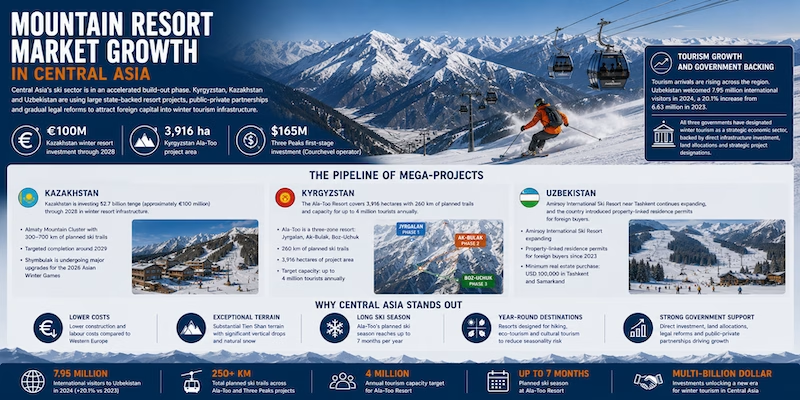
Central Asia’s ski sector is in an accelerated build-out phase. Kyrgyzstan, Kazakhstan and Uzbekistan are using large state-backed resort projects, public-private partnerships and gradual legal reforms to attract foreign capital into winter tourism infrastructure.
Tourism Growth and Government Backing
Tourism arrivals are rising across the region. Uzbekistan welcomed 7.95 million international visitors in 2024, a 20.1% increase from 6.63 million in 2023. All three governments have designated winter tourism as a strategic economic sector, backed by direct infrastructure investment, land allocations and strategic project designations.
The Pipeline of Mega-Projects
Kazakhstan is investing 52.7 billion tenge (approximately €100 million) through 2028 in winter resort infrastructure, including the Almaty Mountain Cluster with 300–700 km of planned ski trails, targeted for completion around 2029. Shymbulak is undergoing major upgrades for the 2026 Asian Winter Games.
In Kyrgyzstan, the Ala-Too Resort covers 3,916 hectares with 260 km of planned trails and capacity for up to 4 million tourists annually. The separate Three Peaks project involves Société des Trois Vallées — the Courchevel operator — planning 200 km of slopes across Jyrgalan, Ak-Bulak and Boz-Uchuk, with a first-stage investment of USD 165 million targeted for completion by end of 2026.
In Uzbekistan, Amirsoy International Ski Resort near Tashkent continues expanding, and the country introduced property-linked residence permits for foreign buyers of real estate above USD 100,000 in Tashkent and Samarkand since 2023.
Why Central Asia Stands Out
The region offers lower construction and labour costs compared to Western Europe, combined with substantial Tien Shan terrain with vertical drops and natural snow. Ala-Too’s planned ski season reaches up to 7 months per year. All three countries are designing resorts as year-round destinations — with hiking, eco-tourism and cultural tourism — to reduce seasonality risk and extend revenue beyond winter.
Investment Landscape by Country
Each country offers a different investment profile — from Kyrgyzstan's large-scale state-backed mega-projects to Kazakhstan's established resort infrastructure and Uzbekistan's property-linked residence permits.
Kyrgyzstan
Home to the largest ski resort project in Central Asia — the Ala-Too Resort at 3,916 hectares near Lake Issyk-Kul. Foreign investors can lease land for up to 49 years. The government is actively auctioning land plots for hotels, restaurants and tourism infrastructure.
Skiing in KyrgyzstanKazakhstan
The most mature ski market in the region, with Shymbulak near Almaty and the planned Almaty Mountain Cluster targeting 300–700 km of trails. Foreign investors typically form Kazakh entities or enter public-private partnerships. Almaty hosts the 2029 Asian Winter Games.
Skiing in KazakhstanUzbekistan
Offering residence permits linked to qualifying property purchases and expanding winter tourism near Tashkent. Amirsoy International Ski Resort is the flagship development. All land remains state-owned, but foreigners can own buildings on leased land.
Skiing in UzbekistanCan Foreigners Buy Property in Central Asia?
Land ownership rules vary across the three countries. In all cases, foreigners cannot own land outright but can lease it long-term or own buildings and structures on leased land. Here is how it works in practice.
Kyrgyzstan
Foreigners cannot own land but can lease it for up to 49 years under Article 8 of the Land Code. A 2024 amendment allows foreigners to acquire recreational property in the Lake Issyk-Kul area.
Since 2013, foreigners can buy and own apartments, houses and commercial buildings without special permission. Foreign companies must register a Kyrgyz legal entity to lease land for tourism projects.
Kazakhstan
Foreigners are generally restricted from owning agricultural land. They can own certain categories of land for residential or commercial use, subject to zoning and approvals.
Foreign investors typically form Kazakh entities or enter public-private partnerships to lease land for tourism projects. Direct foreign freehold ownership of strategic or border-adjacent land may be prohibited.
Uzbekistan
All land remains state-owned. Foreigners cannot own land but can own buildings and structures on leased land. They can purchase apartments and commercial property in designated urban zones including Tashkent, Samarkand and Bukhara.
Since 2023, foreign property owners purchasing real estate above USD 100,000 in Tashkent or Samarkand can apply for temporary residence permits valid up to 3 years, renewable. Foreign companies must register a legal entity for long-term land leases for tourism development near Amirsoy and other projects.
Types of Ski Resort Investments
Foreign capital can enter Central Asia's ski sector through several models. In all cases, investors typically act through local companies that lease land and own structures — outright foreign land ownership is not permitted in any of the three countries.
Land Plot Acquisition
Government auctions offer land plots for tourism development, such as the plots auctioned at Ala-Too Resort in Kyrgyzstan. In practice, most ski-cluster land across Central Asia is allocated strategically to state enterprises rather than sold publicly — making these auctions a relatively rare entry point.
Hotel Development on Leased Land
The most common model: foreign investors develop and own hotels on state-leased land. The government retains land ownership while private capital builds and operates the hospitality infrastructure. This structure is used at Amirsoy in Uzbekistan and across the Ala-Too project in Kyrgyzstan.
Public-Private Partnerships
The state builds core infrastructure — roads, power lines, water, wastewater — while private capital develops hotels, restaurants and services. Both the Ala-Too Resort and Kazakhstan's Almaty Mountain Cluster follow this structure, with Doppelmayr and Société des Trois Vallées as private partners.
Concession Agreements
Private operators manage existing resorts under long-term leases. In 2023, Kyrgyzstan leased four Soviet-era Issyk-Kul resorts to Uzbekistan for 49 years following an ICSID arbitration ruling — demonstrating that concession structures can resolve cross-border investment disputes.
Redevelopment of Existing Resorts
Soviet-era resorts across the region are being modernised. Shymbulak in Kazakhstan is undergoing major upgrades ahead of the 2029 Asian Winter Games in Almaty. Redevelopment of existing ski resorts can be an attractive investment where infrastructure already exists but needs modernisation.
Risks and Considerations
Ski resort investment in Central Asia offers significant opportunity, but carries real risks. Investors should assess each factor carefully before committing capital.
Political and Regulatory Risk
Political landscapes can shift. In Kyrgyzstan, President Japarov's direct supervision of the Ala-Too project shows strong support but also centralises decision-making. Past political debates have affected major projects, and regulatory changes are possible across all three countries.
Infrastructure Gaps
Remote mountain sites often lack adequate infrastructure. Power, water and wastewater facilities may need to be built from scratch. Road access to many resort sites is limited until construction completes, which can delay development timelines.
Seasonality and Climate
Ala-Too's ski season reaches up to 7 months, but season data for other resorts is not publicly quantified. All major projects are designed as year-round destinations to reduce seasonality risk, though ski operations remain winter-bound.
Currency and Cost Risk
Local currencies (KGS, KZT, UZS) have historically shown more volatility against EUR and USD than major currencies. Construction and labour costs are lower than Western Europe, but quantitative cost indices are not publicly available — investors should obtain local bids to quantify.
Legal Protections
ICSID arbitration is operative in the region, as demonstrated by the 2023 case between Kyrgyzstan and Uzbekistan over Issyk-Kul resorts. Bilateral investment treaties provide legal frameworks, but investors should consult the UNCTAD investment treaty database and structure investments to allow recourse to international arbitration where possible.
Frequently Asked Questions
Why invest in ski resorts in Central Asia specifically?
Central Asia offers untapped Tien Shan mountain terrain with high altitude, reliable snowfall and long seasons — at significantly lower land and labour costs than the Alps or Pyrenees. All three governments have designated winter tourism as a strategic economic sector, meaning public infrastructure investment, state-backed mega-projects and growing political will to attract foreign capital.
How long is the ski season in Central Asia?
The Tien Shan range supports ski seasons of up to 7 months at high-altitude resorts, thanks to natural snow retention and elevation. This is longer than many mid-altitude European resorts. All major projects in the region are designed as year-round destinations with hiking, eco-tourism and cultural activities to generate revenue beyond the winter months.
How accessible are the ski resort areas?
Accessibility varies by country and project. Almaty's resorts are within 30 minutes of an international airport. Kyrgyzstan's Issyk-Kul region is served by Karakol Airport with road upgrades underway. Uzbekistan's Amirsoy is approximately two hours by road from Tashkent. Remote greenfield sites typically require new road construction, which governments are funding as part of strategic projects.
Can foreigners buy property in Uzbekistan?
Foreigners cannot own land in Uzbekistan — all land is state-owned. However, foreigners can purchase apartments and commercial property in designated urban zones including Tashkent, Samarkand and Bukhara, and can own buildings on leased state land. Uzbekistan also offers residence permits linked to qualifying property purchases, which can support a long-term investment presence.
What should I consider before investing in a Central Asian ski resort?
Key factors include road and utility access at the site, the legal structure for leasing land through a local entity, alignment with government-prioritised projects for infrastructure support, and year-round revenue potential beyond the ski season. Investors should also assess political stability, currency risk and the availability of bilateral investment treaty protections. See Risks and Considerations above.
How do Central Asian ski resorts compare to other emerging markets?
Central Asia is comparable to Georgia and Armenia in terms of rapid ski capacity expansion and state-backed development, but starts from a lower base. Compared to Turkey and Eastern Europe, Central Asia's advantages are larger vertical drops, longer natural seasons, lower costs and less crowded slopes. The main trade-off is greater distance from Western European source markets and less mature tourism infrastructure.
Latest Articles
Fresh stories from the slopes of Central Asia
One Visa, Three Mountain Ranges: Azerbaijan Joins Central Asia’s Single Permit Push
Kyrgyzstan's president has put a common tourist visa covering Central Asia and Azerbaijan back on the table. For skiers, that would mean three mountain ranges…
Read more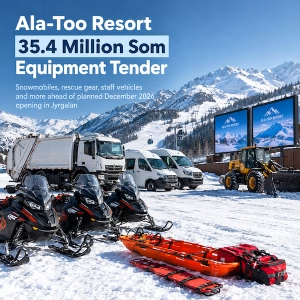
Ala-Too Resort Buys 35.4 Million Som of Winter Gear Ahead of Its December Opening
On October 6, 2026, Kyrgyzstan's flagship mountain cluster posted a public tender for snowmobiles, rescue equipment, a compactor truck and groomers. It is the clearest…
Read more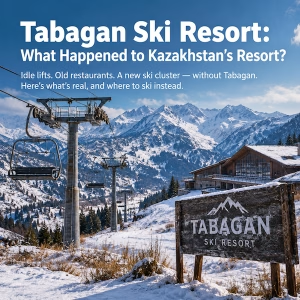
Tabagan | Kazakhstan’s Abandoned Ski Resort and the Future of Almaty Skiing
Tabagan’s cableways are idle, its old restaurants survive only in archived listings, and Kazakhstan is building a new Almaty ski cluster without it. Here is…
Read moreReady to Explore Ski Resort Investments?
Browse current opportunities across Central Asia or learn more about the region's ski destinations driving this growth.