
Almaty SuperSki
A huge new ski area is taking shape around Almaty, with Almaty SuperSki set to connect multiple resorts across the Tian Shan
200+ km connected slopes · 58 planned lifts · 34,000 daily capacity · 20 min from Almaty · Opening Dec 2028
Some links are affiliate — we may earn a commission at no extra cost to you.
About Almaty SuperSki
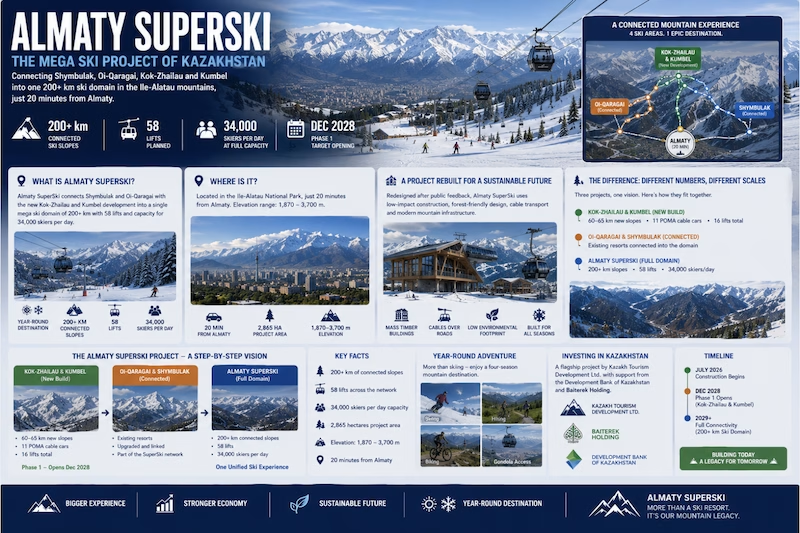
Almaty SuperSki is a mega ski project near Almaty, Kazakhstan, designed to connect existing ski resorts — Shymbulak and Oi-Qaragai — with the new Kok-Zhailau and Kumbel development into a single interconnected ski domain of over 200 kilometres. It is part of the broader Almaty Mountain Cluster, officially presented to Prime Minister Olzhas Bektenov in 2025.
What Is Almaty SuperSki?
The project is managed by Kazakh Tourism Development Ltd. (KTD), a subsidiary of Qazaqstan Investment Corporation under the state holding Baiterek, with financing from the Development Bank of Kazakhstan. When complete, the connected ski domain will feature 58 lifts and accommodate 34,000 skiers per day — a 5.6-fold increase from the current capacity of about 6,000. The project is designed as a year-round mountain destination, not winter-only, with hiking, biking, and gondola access planned alongside the ski infrastructure.
Where Is It Being Built?
Almaty SuperSki is located in the Ile-Alatau National Park in the northern Tien Shan mountains, just outside Almaty city. The total project territory covers 2,865 hectares at an elevation range of 1,870 to 3,700 metres. The mountains are approximately 20 minutes by road from central Almaty, making it one of the most accessible ski destinations from a major city in Central Asia.
A Project Redesigned from Scratch
The original Kok-Zhailau development was halted in 2019 by President Kassym-Jomart Tokayev after public opposition over environmental concerns. The project was redesigned from scratch with a reduced environmental footprint — emphasising mass timber construction, cable transport over roads, and development within permitted recreational zones. Construction officially began in July 2026, with the first phase targeted to open in December 2028.
Understanding the Scope
Three related projects are often confused. Here is the difference between the new build, the connected domain, and the wider cluster vision.
The full interconnected ski domain linking Shymbulak, Oi-Qaragai, and the new Kok-Zhailau/Kumbel development into one network. This is the main project covered on this page.
The umbrella project spanning the entire mountain arc from Turgen to Kaskelen. Includes future areas like Pioneer, Kimasar, Butakovka, and Kaskelen. Almaty SuperSki is one component of this vision.
The flagship new ski resort at Kok-Zhailau gorge and Kumbel Peak (3,200 m). 60–65 km of new slopes with 11 cable cars by POMA. This is the construction component of Almaty SuperSki.
11 cable cars = the POMA contract for the new Kok-Zhailau build. 16 lifts = all lift types at Kok-Zhailau (including surface lifts), with a combined capacity of 34,960 persons per hour. 58 lifts = the full Almaty SuperSki connected domain, including existing Shymbulak lifts and future areas. These are not contradictory — they measure different scopes.
The Almaty Mountain Cluster
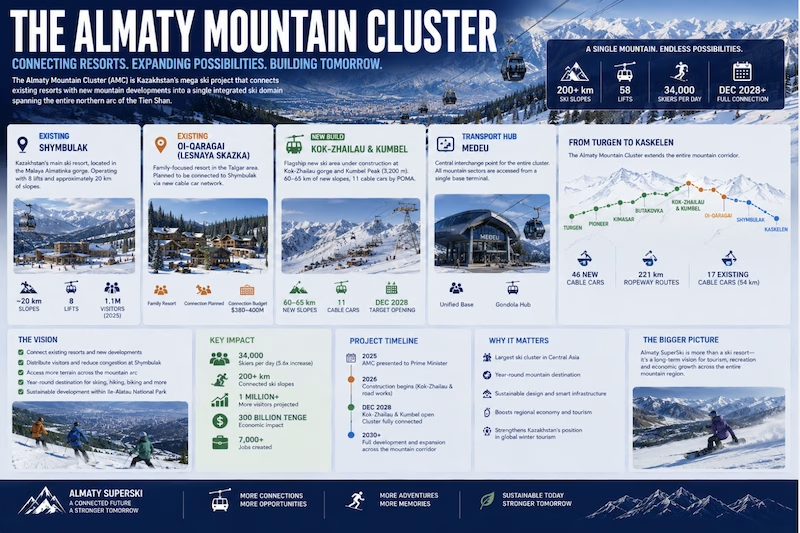
The Almaty Mountain Cluster (AMC) is the umbrella project that connects existing ski resorts with new mountain developments into a single integrated ski domain. Officially presented to Prime Minister Olzhas Bektenov in 2025, it spans the entire mountain arc north of Almaty.
Connecting Existing Resorts
Government master plans envision connecting Shymbulak and Oi-Qaragai with the new Kok-Zhailau and Kumbel development. Shymbulak, currently Kazakhstan's flagship resort with about 20 km of slopes and 8 lifts, received 1.1 million visitors in 2025. On peak days, crowds reach 15,000 people — far exceeding the resort's capacity, with queue times longer than typical Alpine resorts. The AMC aims to solve this by distributing visitors across multiple connected areas.
Kazakhstan's main ski resort, located in the Malaya Almatinka gorge. Operating with 8 lifts and approximately 20 km of slopes.
~20 km slopes · 8 lifts · 1.1M visitors (2025)Family-focused resort in the Talgar area. Planned to be connected to Shymbulak via new cable car network.
Connection budget: $380–400MThe flagship new ski area under construction at Kok-Zhailau gorge and Kumbel Peak (3,200 m). 60–65 km of new slopes, 11 cable cars by POMA.
60–65 km new slopes · 11 cable cars · Dec 2028The central interchange point for the entire cluster. All mountain sectors are accessed from a single base terminal at Medeu.
Unified base terminal · Gondola hubFrom Turgen to Kaskelen
The broader AMC vision extends beyond the four core locations. The full mountain corridor runs from Turgen in the east to Kaskelen in the west, with future connections to Pioneer, Kimasar, Butakovka, and additional valleys. Currently the central corridor has 17 cable cars covering 54 km. The full plan adds 46 new cable car lines totalling 221 km of ropeway routes, bringing the total to 58 lifts in the central area.
Instead of separate base stations for each resort, visitors arrive at a single transport hub at Medeu. From there, cable cars distribute skiers across all mountain sectors — reducing road traffic within the national park and simplifying movement between areas.
How Big Will It Become?
When fully connected, the ski domain is planned to have over 200 km of slopes and accommodate 34,000 skiers per day — a 5.6-fold increase from today's capacity of 6,000. Merging Shymbulak and Oi-Qaragai alone is projected to bring 1 million additional tourists and 300 billion tenge to the local economy.
While Almaty SuperSki's 200+ km will make it one of the largest ski areas in Central Asia, the Ala-Too resort project in Kyrgyzstan plans 250 km of slopes, making it the largest mega project in the region.
What's Next — Timeline to Opening
Construction is underway. Here is what happens between now and the opening of Almaty SuperSki.
Construction Underway
Work has begun on technological roads, construction access, engineering infrastructure, earthworks, and site preparation for lift foundations. International contractors — POMA, Foster + Partners, StructureCraft, and Hill International — were selected in June 2026. Public hearings in May 2026 approved the project with active community debate on ecology, water, and transport.
Lift Installation & Building
The focus shifts to installing 46 new cable car lines across the mountain cluster, adding 221 km of ropeway routes. Shymbulak is being expanded with 7 additional cable car lines and modernisation of 2 existing lifts. Hotels, restaurants, and visitor facilities are constructed at Kok-Zhailau and across the connected areas.
First Phase Opening
The first phase is targeted to open, providing access to the new Kok-Zhailau and Kumbel ski area with its 60–65 km of slopes and 11 cable cars by POMA. The Shymbulak – Oi-Qaragai cable car connection (budget: $380–400M) is expected to link existing resorts into the network.
Full Connected Domain
Subsequent phases will bring all facilities into full operation. The connected ski domain of 200+ km of slopes and 58 lifts is the planned end state, with a daily skier capacity of 34,000. Year-round programmes — hiking, biking, gondola tourism — launch alongside the winter operation.
Construction Status & International Contractors
Construction officially began in July 2026 after contractors were selected through an open tender process in June 2026. The government press service confirmed that independent monitoring was conducted by PGI, Hill International, and DCSA throughout the selection process. Prime Minister Olzhas Bektenov directed strict control over timelines, quality, safety standards, and environmental responsibility.
| Company | Country | Role |
|---|---|---|
| POMA (HTI Group) | France | 11 cable car lifts — ropeway system. Building ski lifts since 1936; ~7,800 installations at 750 resorts worldwide. |
| Foster + Partners | UK | Architectural design of lift stations. Norman Foster's firm — also designed Khan Shatyr (Astana), 30 St Mary Axe (London), Hearst Tower (New York). |
| StructureCraft | Canada | Engineering and manufacturing of prefabricated timber structures for all resort buildings. |
| Hill International | USA | Project management and quality control. Ensures adherence to international safety and environmental standards. |
| Pas Grau International | Andorra | Preliminary design of Almaty SuperSki. Led by Joan Viladomat. Registered subsidiary in AIFC for long-term commitment. |
| Horwath HTL | USA | Tourism consulting and master plan. Economic projections and demand segmentation. |
| STEM International | France | Sustainability and all-season development. Represented by Vincent Tassart. |
POMA Cable Car System
POMA won the open tender to build 11 cable car lines for Almaty SuperSki, ranging from chairlifts to large enclosed gondolas. The company has been manufacturing ropeway systems since 1936 and has installed approximately 7,800 installations at 750 resorts across Europe, Asia, and the United States.
Foster + Partners Architecture
The lift stations at Medeu and Kok-Zhailau were designed by Foster + Partners, the architecture firm of Norman Foster. The design draws inspiration from the Kazakh yurt — incorporating kerege (lattice wall), uyk (poles), and shanyrak (top dome light element). Buildings use prefabricated timber engineered by StructureCraft, with panoramic terraces offering views of Almaty and the Ile-Alatau mountains.
Independent tender monitoring: PGI · Hill International · DCSA
Infrastructure & Design
11 Cable Cars at the New Kok-Zhailau Build
The new ski area at Kok-Zhailau and Kumbel is served by 11 cable car lines running from the base station at Medeu (1,870 m) to the summit of Kumbel peak (3,400 m). The system includes modern 3S gondolas, 10-person gondolas, and chairlifts. All lifts are designed to be accessible for children, elderly visitors, and people with disabilities. The full connected domain will have 58 lifts across all areas, including existing Shymbulak lifts and future sectors.
Instead of separate base stations for each resort, visitors arrive at a single transport hub at Medeu. From there, cable cars distribute skiers across all mountain sectors — Shymbulak, Kok-Zhailau, Kumbel, and future areas — reducing road traffic within the national park.
Yurt-Inspired Architecture
The lift stations at Medeu and Kok-Zhailau are designed by Foster + Partners, incorporating elements of the traditional Kazakh yurt: kerege (the lattice wall), uyk (the wooden poles), and shanyrak (the circular top dome and light element). The buildings use prefabricated timber engineered by StructureCraft, with panoramic terraces offering views of Almaty and the Ile-Alatau mountains.
Hotels & Facilities
Six hotels are planned at the new Kok-Zhailau resort with a total of 6,000 beds: one five-star hotel, four four-star hotels, and boutique/apart-hotels. Dining includes 4–5 new restaurants plus a mountaintop restaurant and a viewing platform at the summit, both accessible via cable car.
1 five-star, 4 four-star, plus boutique and apart-hotels distributed across the resort zones.
4–5 new restaurants plus a mountaintop dining facility with panoramic views.
Access & Transport
Primary access is via a new cable car from Medeu, using large cabins with a minimal number of towers to reduce landscape impact. A road access route via the Big Almaty Gorge and Navoi corridor is planned for public transport, taxis, and electric vehicles only. The mountains are approximately 20 minutes by road from central Almaty.
Skiing & Terrain
200 Kilometres of Connected Slopes
When fully connected, Almaty SuperSki is planned to offer over 200 km of slopes across the entire mountain domain. The new Kok-Zhailau and Kumbel area contributes 60–65 km of new slopes, plus 9 additional ski routes totalling 13.6 km. The existing Shymbulak adds approximately 20 km, with Oi-Qaragai and future sectors completing the network. The terrain spans an elevation range of 1,870 to 3,700 metres.
155 ha of ski trails · 16 lifts (all types) · 34,960 persons/hour capacity · 11 POMA cable cars
All connected areas including Shymbulak (~20 km), Oi-Qaragai, and future sectors · 58 lifts total
Built for Beginners
A defining feature of the new Kok-Zhailau build is its focus on accessible skiing. At least 35 km of the new slopes — roughly half the new terrain — are dedicated to beginners and easy recreational skiing. The daily skier capacity across the full connected domain increases from the current 6,000 to a planned 34,000, with a simultaneous capacity of 10,150 skiers at the Kok-Zhailau area alone. Expert terrain and off-piste zones are also available for advanced skiers.
Artificial Snow System
To guarantee reliable conditions throughout the season, 70% of the new Kok-Zhailau slopes (42.2 km) are equipped with artificial snowmaking. The system uses SnowFactory all-weather snow generator technology, powered by 3 artificial reservoirs filled from the Kazachka River. Annual snow production requires 355,000 m³ of water, with daily operation consumption of 2,700 m³.
A Four-Season Mountain Destination
Beyond Skiing
Almaty SuperSki is designed for year-round use, not just winter. Three of the 11 cable cars at the new Kok-Zhailau build are dedicated to summer activities, providing access to a mountaintop restaurant and a viewing platform. The all-season approach is essential for improving investment returns and reducing seasonality — a contrast with traditional Soviet-era ski resorts that operated only in winter.
Walking routes across the Kok-Zhailau plateau — already a popular hiking destination
Cycling routes being developed for the Kok-Zhailau gorge
3 cable cars serve summer visitors — sightseeing and scenic rides for non-skiers
Mountaintop restaurant and viewing platform accessible via cable car
Summer in the Mountains
When the snow melts, the Kok-Zhailau plateau becomes a base for hiking and mountain biking. Walking and cycling routes are being developed for the gorge, and the cable car network provides access to terrain that was previously reachable only on foot. Family recreation areas and sightseeing opportunities extend the resort's appeal well beyond the ski season.
Year-Round Operation
The resort is designed to operate year-round, with only a few weeks of closure in May or October for lift maintenance. This continuous operation model — combining winter skiing, summer hiking and biking, and year-round gondola access — is designed to make Almaty SuperSki a viable destination in every season.
3 of 11 cable cars (at the new Kok-Zhailau build) serve summer activities · Mountaintop restaurant & viewing platform accessible year-round · Maintenance closure: a few weeks in May or October
Environmental Story: From Controversy to Redesign
The 2019 Halt
The Kok-Zhailau area is a sensitive site within the Ile-Alatau National Park. Previous attempts to develop the area in 2018 and 2019 were suspended after strong public opposition over ecological concerns. In 2019, President Kassym-Jomart Tokayev ordered a halt to construction following unprecedented social unrest — making Kok-Zhailau a symbol of resistance against development in protected mountain landscapes.
A New Approach
The redesigned Almaty SuperSki project takes a fundamentally different approach: mass timber buildings instead of concrete, cable transport instead of roads, fewer permanent structures, and development confined to permitted recreational zones within the national park. Deputy PM Aida Balayeva confirmed in May 2026 that the land is not removed from protected status and that no private cottages or closed villas will be built. The project zone is classified as a "zone of restricted economic activity" — tourism infrastructure is allowed, but land categories cannot be converted.
Of the total 2,865 hectares of project territory, only approximately 20 hectares are reserved for built development (hotels and service buildings). Ski trails cover approximately 155 hectares. The remainder stays as natural mountain landscape.
Ongoing Scrutiny
Public hearings were held on May 26, 2026 in Almaty, where the project was approved by the community — though with active debate about ecology, water use, transport, and avalanche safety. The general plan had not yet been agreed with the national park administration as of January 2026. Environmental impact assessments have not been made public as of mid-2026, and Forbes reported that the updated project actually increased ecological load compared to earlier calculations. Ecologists, including the organisation Green Salvation (Zelenoe Spasenie), remain cautious and continue to scrutinise the project. The government has promised an open and transparent process, with European consultants experienced in Alpine environmental standards involved in the planning.
Mega Ski Resorts of Central Asia
Three major ski development projects are reshaping winter tourism across the region. Almaty SuperSki is the second largest by planned slope length.
State-backed mountain cluster centred on Jyrgalan, Ak-Bulak, and Boz-Uchuk. Phase 1 opening December 2026 with the first two cable cars already technically launched.
Interconnected mega project linking Shymbulak, Oi-Qaragai, and the new Kok-Zhailau/Kumbel development. Construction underway since July 2026.
Operational resort in the Western Tien Shan, built with European engineering. Currently expanding with new lifts and trails.
Visiting Almaty
Ski Almaty Today
Almaty SuperSki is not yet open, but you can ski at Shymbulak today. With approximately 20 km of slopes and 8 lifts, Shymbulak is Kazakhstan's main ski resort and received 1.1 million visitors in 2025. It serves as the core of the future Almaty SuperSki network — what you ski now at Shymbulak will eventually become part of the 200+ km connected domain.
~20 km slopes · 8 lifts · 1.1M visitors (2025)
Largest airport in Kazakhstan serving Central Asia
Getting to the Mountains
Shymbulak is located in the Malaya Almatinka gorge, about 25 minutes from Almaty city centre. Access is via the Medeu area, where a cable car takes you up to the resort. Once Almaty SuperSki opens, this same Medeu area will serve as the unified transport hub for the entire connected ski domain — a single base terminal distributing visitors across all mountain sectors.
City and Mountains
Almaty is the largest city in Kazakhstan and a cultural and culinary hub. In 2025, the city received about 2.5 million tourists, with Kazakhstan overall attracting 15.3 million international visitors in 2024. The proximity of the mountains — just 20 minutes from the city centre — allows visitors to ski by day and enjoy Almaty's restaurants, cafes, and urban comforts by night.
Frequently Asked Questions
Construction is targeted to finish in December 2028, with full commissioning of all facilities in subsequent phases. The first phase includes the new Kok-Zhailau and Kumbel ski area and the planned Shymbulak – Oi-Qaragai cable car connection.
The full connected ski domain is planned to have over 200 km of slopes. The new Kok-Zhailau and Kumbel area contributes 60–65 km of new pistes, with the remainder coming from existing resorts like Shymbulak and future connected areas.
No. The Ala-Too resort project in Kyrgyzstan plans 250 km of slopes, making it the largest mega project in Central Asia. Almaty SuperSki at 200+ km will be the second largest.
The new ski area is at the Kok-Zhailau gorge and Kumbel Peak (3,200 m), within the Ile-Alatau National Park in the northern Tien Shan mountains. The mountains are approximately 20 minutes by road from central Almaty.
POMA (France), part of the HTI Group, won the open tender to build 11 cable car lines for the new Kok-Zhailau build. POMA has been manufacturing ropeway systems since 1936, with approximately 7,800 installations at 750 resorts worldwide.
Yes. The resort is designed for year-round operation. Three of the 11 cable cars at the new Kok-Zhailau build serve summer activities, including a mountaintop restaurant and viewing platform. Hiking, mountain biking, and gondola tourism are planned alongside winter skiing, with only a few weeks of closure in May or October for maintenance.
Public hearings were held on May 26, 2026 and the project was approved by the community. However, environmental impact assessments have not yet been made public, and the general plan had not been agreed with the national park administration as of January 2026. Ecologists remain cautious.
The mountains are approximately 20 minutes by road from central Almaty. The unified base terminal at Medeu serves as the access point for all mountain sectors. Almaty International Airport (ALA) is the nearest airport.
Latest Articles
Fresh stories from the slopes of Central Asia
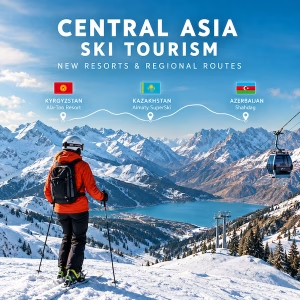
One Visa, Three Mountain Ranges: Azerbaijan Joins Central Asia’s Single Permit Push
Kyrgyzstan's president has put a common tourist visa covering Central Asia and Azerbaijan back on the table. For skiers, that would mean three mountain ranges…
Read more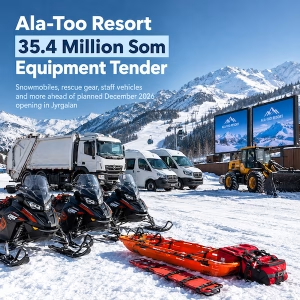
Ala-Too Resort Buys 35.4 Million Som of Winter Gear Ahead of Its December Opening
On October 6, 2026, Kyrgyzstan's flagship mountain cluster posted a public tender for snowmobiles, rescue equipment, a compactor truck and groomers. It is the clearest…
Read more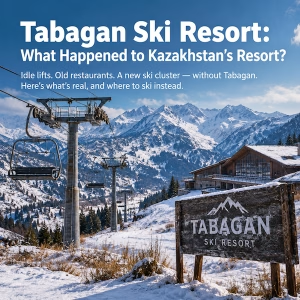
Tabagan | Kazakhstan’s Abandoned Ski Resort and the Future of Almaty Skiing
Tabagan’s cableways are idle, its old restaurants survive only in archived listings, and Kazakhstan is building a new Almaty ski cluster without it. Here is…
Read moreReady to Ski Central Asia?
Almaty SuperSki opens in December 2028. Until then, you can ski at Shymbulak — the core of the future connected domain.
Ski Shymbulak Today →Explore Kazakhstan Ski Resorts


