
Kyrgyz President Sadyr Japarov says Kazakhstan and Uzbekistan support one shared tourist visa, a change that could turn a three-country ski trip into a single application
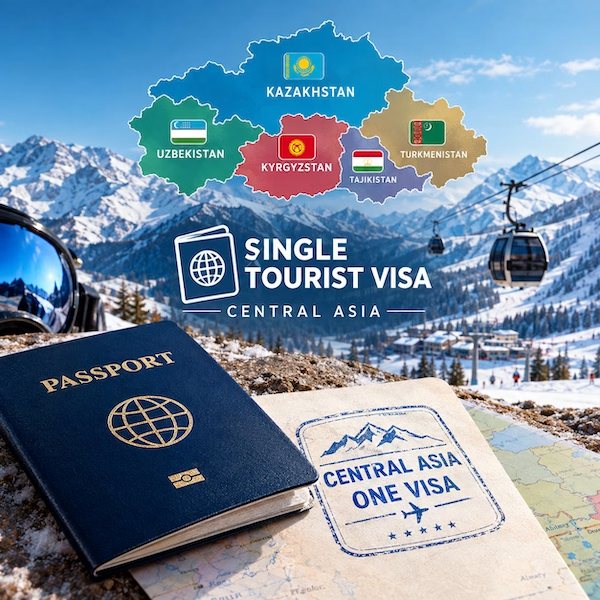
Skiing three countries in one week has always been the great Central Asian fantasy. Shymbulak above Almaty, Ala-Too in the Issyk-Kul region, Amirsoy beyond Tashkent — all close together on the map, all far apart at the border. The mountains are near. The paperwork is not.
That may have started to shift on July 31, 2026. Speaking at an informal summit of regional leaders in Cholpon-Ata, on the shores of Lake Issyk-Kul, Kyrgyz President Sadyr Japarov formally proposed a single tourist visa for Central Asia. He said that Kazakhstan and Uzbekistan support the initiative.
The idea is straightforward. Foreign visitors would explore multiple Central Asian countries on one visa, instead of dealing with separate national entry systems.
Japarov first floated the concept in March 2025. Until now it remained a proposal. The July 2026 announcement is the first clear indication that his initiative has won support from Kazakhstan and Uzbekistan.
It is also not the first attempt at regional visa simplification. Kazakhstan and Uzbekistan promoted a “Silk Road Visa” beginning in 2018, with the idea later expanded into a broader regional tourism initiative. It was never implemented as an operational common visa.
Why a Single Visa Changes the Ski Trip
For skiers, this is the practical part. A single visa could remove a major logistical barrier to multi-resort trips.
Right now, a skier wanting to visit Shymbulak in Kazakhstan, Ala-Too in Kyrgyzstan, and Amirsoy in Uzbekistan has to deal with the entry rules of three separate countries. The exact requirements depend on the passport, but each country has its own rules and permitted length of stay.
A common regional visa would put those three systems behind a single application. Fly into one hub, ride lifts in three countries, fly home from another.
The terrain to justify it already exists. Kazakhstan, Kyrgyzstan and Uzbekistan have a growing network of lift-served ski areas, from major international resorts to smaller local ski bases. Our current inventory counts 38 lift-served ski areas with more than 187 km of listed slopes across the three countries.
For many Western passports, the friction is already falling. Kazakhstan offers 30-day visa-free entry to citizens of the EU, United States, UK, Canada, Australia and numerous other countries. Kyrgyzstan allows citizens of dozens of countries, including the United States, Canada, UK, Australia and most EU states, to enter visa-free for up to 30 days within each 60-day period.
Uzbekistan also closed much of the gap on January 1, 2026, when it introduced 30-day visa-free entry for U.S. citizens.
For travelers who already qualify for visa-free entry in all three countries, the immediate benefit of a common visa would therefore be smaller. The bigger change would be the creation of one coordinated regional framework, particularly for nationalities that currently face visa requirements in one or more of the three countries.
Who Is In, and Who Is Still Out
The July 2026 summit brought together presidents from all five Central Asian states plus Azerbaijan. Japarov, however, specifically named Kazakhstan and Uzbekistan as supporters of his single-visa initiative.
Tajikistan has expanded its visa-free regime and operates an e-visa system, but it was not publicly identified by Japarov as a supporter of the proposal.
Turkmenistan remains the most restrictive of the five for Western tourists. It does not generally offer visa-free access to Western visitors. A legal framework for electronic visas was introduced in 2025, but a normal self-service tourist e-visa system does not yet appear to be operational. In practice, visitors continue to face a much more restrictive visa process.
So a true five-country Central Asian ski circuit would still involve separate national entry arrangements. The realistic version of this plan is a Kazakhstan–Kyrgyzstan–Uzbekistan loop, and that is already the combination most relevant to international ski tourism.
What Skiers Should Plan For in 2026-2027
Here is the sober part. Despite the political support, no signed agreement, implementation date or operational common visa has been announced.
Instead, the countries’ foreign ministries have been called on to intensify consultations and work toward coordinated positions. That points to an early consultation stage, not a visa system that travelers can apply for today.
For skiers planning the 2026-27 season, the current national visa and visa-free rules remain the operative framework. Check each country’s rules for your passport before you book, and build your itinerary around what is actually in force.
The takeaway: the single visa is now politically real in a way it was not when the earlier Silk Road Visa stalled, but it is not yet something you can apply for. Watch the foreign ministry consultations over the coming months. If the proposal develops into a formal agreement, a Shymbulak–Ala-Too–Amirsoy week could become one of Central Asia’s most intriguing multi-country ski trips.