
China’s CHMC joins Valmont Group and Eldik Bank in the $127.9 million Baytik Mountain Resort project, about 35 km from Bishkek, as Kyrgyzstan develops two major mountain resorts at once.
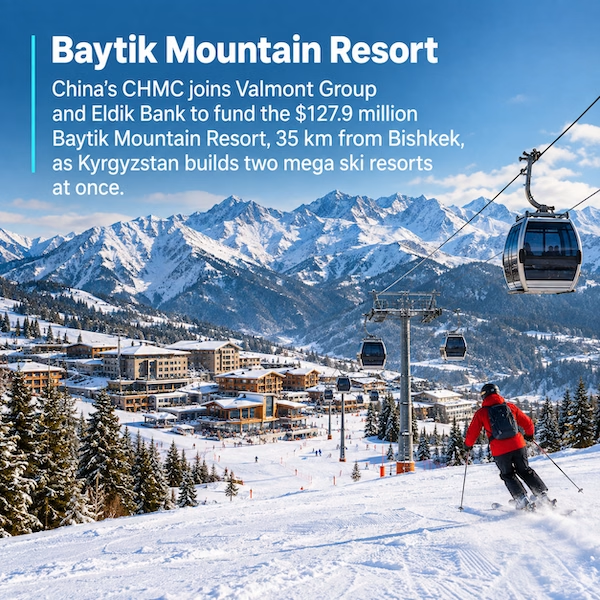
If you have tried to ski in Kyrgyzstan, you know the problem. The country’s best-known existing ski destination, Karakol, sits roughly 400 kilometres from the capital. That is a long day of travel for a short day of snow.
Bishkek is about to get a mountain of its own. On August 27, 2026, a new public-private partnership agreement brought Chinese financing into the Baytik Mountain Resort project, giving the long-planned development its clearest implementation framework yet. The scale of that bet is worth understanding.
Two Mega-Resorts, One Deliberate Strategy
Kyrgyzstan is pursuing two huge mountain-resort projects at once, with Baytik and Ala-Too offering very different approaches to the country’s winter tourism future. Baytik is the newer of the two, and it is the project that secured new Chinese financing arrangements in August 2026.
The public-private partnership agreement was signed on August 27 at Kyrgyzstan’s National Investment Agency. The following day, a separate Kyrgyz-Chinese investment forum was held in Bishkek, where more than $300 million in agreements, memoranda and commercial contracts were signed across several sectors.
China National Heavy Machinery Corporation (CHMC) is the strategic financing partner under an EPC+F model, while Valmont Group and state-owned Eldik Bank are also part of the project’s financing structure. The project had previously been the subject of a trilateral memorandum involving the Eurasian Development Bank.
The total project value is now set at $127.9 million, up from an earlier project estimate of more than €101 million.
The Baytik deal came as part of a much larger expansion of Kyrgyz-Chinese economic cooperation. The August 28 forum produced agreements covering tourism, infrastructure, electricity and heating, oil and gas, water management, agriculture and other sectors.
Chinese companies in Kyrgyzstan have historically been heavily involved in infrastructure and energy, and the arrival of Chinese financing for a major tourism project shows the growing international interest in the country’s mountain tourism potential.
Baytik is also distinct from the country’s other major project, the Ala-Too Resort near Issyk-Kul. The broader Ala-Too development has been presented with a long-term budget of around €1.2 billion, while plans have called for roughly 250–260 km of ski slopes and capacity to attract up to 2 million visitors annually once fully developed.
Baytik makes the opposite pitch. At around 35 km from Bishkek, it targets short-stay, accessible ski trips rather than a multi-day expedition. For residents of the capital, a day on the slopes could become a realistic weekend or even short-notice trip.
What Gets Built, and Why It Matters
Earlier project plans called for more than 50 km of slopes, 22 lifts and capacity for up to 10,000 skiers per day, with the resort operating as a four-season destination.
The first phase of infrastructure is expected within four to five years, putting the project on a broad 2030 implementation timeline.
Employment projections are 1,500 construction jobs and at least 800 permanent positions, with at least 80% of permanent roles reserved for Kyrgyz citizens.
The site is not virgin ground. Kashka-Suu village, where Baytik is planned, has hosted ski activity since the Soviet era, with a ski club established there in 1976.
The gorge already hosts small ski facilities, meaning the new project builds on an established recreational area rather than introducing skiing to a completely undeveloped mountain location.
The economics help explain the ambition. Foreign visitors spent around $1.1 billion in Kyrgyzstan in 2025, an increase of 8.1% from the previous year, while tourism’s share of GDP reached 3.8%. That is real money, but tourism remains highly seasonal.
Both mountain resorts are designed as year-round destinations, potentially helping Kyrgyzstan broaden mountain tourism beyond its traditional summer and Issyk-Kul season.
If you ski in Central Asia, Baytik is the project to watch first. It is closer, easier to reach from the capital, and now has a formal financing and implementation framework that makes it one of Kyrgyzstan’s most significant new winter-tourism projects.