
Tabagan’s cableways are idle, its old restaurants survive only in archived listings, and Kazakhstan is building a new Almaty ski cluster without it. Here is what can actually be verified about the sleeping resort — and where you can ski instead.
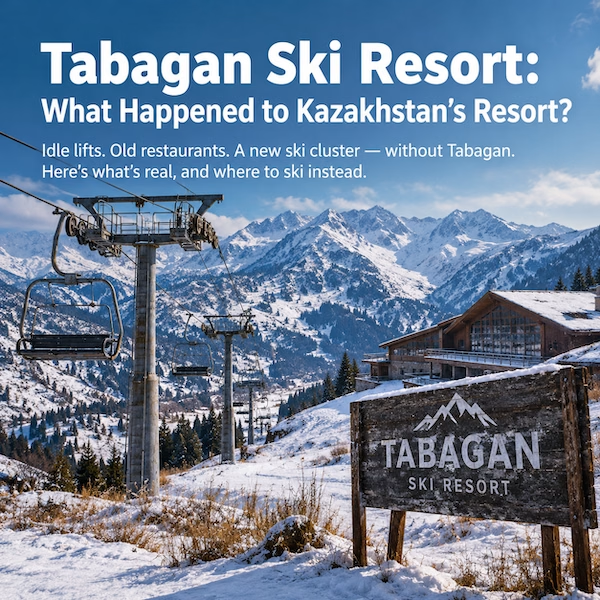
Tabagan’s cableways are idle, its three restaurants still show up in historical resort material, and Google Maps still presents it as a ski mountain. Meanwhile Kazakhstan is putting billions of tenge into an Almaty mountain cluster whose current development scope does not include Tabagan. Here is everything that can actually be verified about the sleeping resort, and where you should ski instead.
Somewhere above the Talgar valley, cableway equipment and other resort structures are still standing after years without operation. The chairs hang still. The upper runs sit under snow that nobody tracks.
And yet if you search for Tabagan on Google Maps today, you may still find a ski mountain listing that looks like a functioning resort. That is the gap that makes Tabagan so strange. A resort can be non-operational for years and still look perfectly alive on the internet.
So what is really going on at Tabagan, and does it have any future inside the biggest ski build-out Central Asia has ever attempted?
Tabagan Today: Lifts Standing, Slopes Silent
Start with the hardest fact. As of 2026, Tabagan’s ski infrastructure is not operating for skiing. A 2026 public-hearing record says Tabagan has not functioned for more than 10 years.
A 2024 investigation described damaged cableways, a ruined stadium and a looted hotel, while Centerproject, a subsidiary of Bank CenterCredit managing distressed assets, described the property as non-operational.
The infrastructure has not simply disappeared. Cableway equipment and other structures remain on the site, although they are in poor condition.
For a skier, that distinction matters less than it seems. Either way, you cannot plan a normal ski day there. The upper mountain is not serving turns.
No Closure Notice, No Season Announcement
Here is where the story gets strange. In the sources reviewed for this article, no formal public notice declaring Tabagan permanently closed was found.
At the same time, no current 2025-2026 ski-season operational announcement was found in the material reviewed. There is no verified opening-date announcement or current ski-season information in the sources used here.
So the resort is operationally closed, even though the sources reviewed do not provide a formal permanent-closure announcement.
That distinction matters because Tabagan is not simply an abandoned ski hill with nobody interested in it. The property is still being discussed as an asset that could potentially be developed.
Google Maps Still Calls It a Ski Mountain
Google Maps has continued to present Tabagan as a ski-related mountain destination, but live ratings and categories can change, so the listing should be treated as a current map reference rather than proof of operation.
The important point is that a traveller searching online can still encounter information that presents Tabagan as a functioning mountain resort, while the more recent evidence says the resort itself has not operated for years.
That is the misleading part of the story. A ski resort can remain highly visible online long after its lifts stop turning.
The Hotel Side Kept Appearing Online
The lower complex is a separate question from the ski hill. Historical material from the resort’s official website presented Tabagan as a ski and sports-entertainment complex and listed accommodation and leisure facilities.
That material is historical, however. The accessible archived official material is from 2019, so it proves how the resort presented itself at the time, not that those facilities continued operating afterward.
A 2024 investigation found that the lower part of the complex had been restored by a tenant, including cabins and a restaurant, while the upper part was not functioning normally.
So for a period, you had an odd split: a ski hill going quiet while parts of the hospitality operation continued to exist or be presented as a usable resort. That is what “sleeping resort” actually looks like in practice.
Three Restaurants, a Pool and a Sauna
Historical resort material lists three restaurant venues: Tabalandiya (Табаландия), Tabakerka (Табакерка) and Taperias (Тапериас).
The same historical material describes leisure facilities including a swimming pool and sauna, as well as other recreational facilities.
None of this should be read as evidence that the restaurants or leisure facilities are operating today. They are part of Tabagan’s documented historical resort offering.
For a mountain lodge close to Almaty, that was a genuine resort amenity set rather than a bare beds-and-breakfast operation.
What the Website Never Mentioned
There are also amenities that cannot be established from the first-party material reviewed for this article.
Claims about tennis courts, a mini-football pitch or boxing facilities therefore remain unverified here.
This is a good habit for any resort research. Compare what a property actually documented about itself against what other sites say about it. The two lists rarely match.
Where Tabagan Actually Sits
Administratively, the resort is in Almaty region, Talgar district — Алматинская область, Талгарский район.
That places it in the broader Ile-Alatau mountain area, in the same wider mountain region as Shymbulak, Oi-Qaragai and Ak-Bulak. Oi-Qaragai is just a 5 minutes drive from Tabagan, and this resort is fully open.
The geography is the reason Tabagan was ever taken seriously. It sits close enough to Almaty for a day trip and inside a mountain range that is now being redeveloped at national scale.
Is the Lower Hotel Still Open? Nobody Can Confirm It
This is the question that matters most if you were thinking of booking a night. Whether the lower hotel is still open as of October 2026 cannot be confirmed from the evidence reviewed.
The 2024 investigation said a tenant had restored part of the lower complex, including cabins and a restaurant. That does not establish that the facilities remain open in 2026.
Practical advice: do not assume. Treat any historical booking information as historical unless you can confirm current operation directly.
Who Owns Tabagan? The Paper Trail Isn’t There
You would expect a resort in this position to generate paperwork. Bankruptcy filings, debt problems, an asset transfer. Tabagan has had all of those things.
The resort stopped operating after its owner ran into financial problems and could not repay the bank. In 2021, the asset was transferred to the balance of a bank subsidiary.
That subsidiary is Centerproject, a Bank CenterCredit company responsible for managing distressed and non-performing assets. A Centerproject representative described work around the property and its potential development.
The Almaty-region akimat has also said that the bank is looking for investors for the property’s further development.
So the property is not simply sitting there with no one involved. It is a distressed asset under bank control, with efforts being discussed around its future development.
SuperSki: The Megaproject Being Built Next Door
While Tabagan sits still, something enormous is happening in the same mountain range. The Almaty Mountain Cluster and Almaty Superski projects are government-backed and have moved into practical implementation, with an official launch target of December 2028.
The contracts read like a who’s who of the global ski industry. POMA has been selected to build 11 modern cableways.
The architectural concept includes Foster + Partners, the British practice known for large-scale civic and infrastructure work.
At the political level, Prime Minister Olzhas Bektenov has reviewed the development of the Almaty mountain cluster and Almaty Superski. That is prime-ministerial attention, not a regional side project.
From 16 Lifts to 58
The scale of the plan is the clearest signal of intent.
The original 2025 comprehensive development plan for the Almaty mountain cluster was valued at approximately 655.9 billion tenge for 127 measures, funded through national, local and private sources.
But that is not necessarily the latest figure. Later reporting said the programme had been revised to 73 measures with an estimated cost of 526.1 billion tenge.
On the ground, the numbers are just as stark. The plan calls for lifts in the central zone to increase from 16 to 58.
The same planning material gives a target of 227 km of ski pistes and capacity of up to 34,000 people per day.
These are planning targets, not completed infrastructure.
Either way, this is the largest mountain-infrastructure build in Kazakhstan’s history, and it is happening while Tabagan’s chairs hang motionless a short distance away.
Tabagan Isn’t in the Current Development Scope
Now the crucial detail for anyone who still has feelings about Tabagan.
Tabagan is outside the current development stage of the Almaty mountain-cluster project. An official public-hearing response says that Tabagan and Ak-Bulak were excluded after the boundaries of the development stage were updated.
And there is an even more interesting detail. Tabagan had originally been included in the technical assignment for mandatory consideration, but was later excluded from the final materials when the project’s scope and boundaries were updated.
This is the single most important fact in the whole story. An existing resort with cableway infrastructure and other facilities was considered during the planning process, but it is not part of the current development stage.
That does not mean Tabagan has been ruled out of every possible future redevelopment. The same public record says the district akimat is working on development of the territory and that the bank is working on attracting investors.
But Tabagan Used to Be in the Plans
Here is where the story gets frustrating for locals who remember the earlier conversations.
Tabagan appeared in earlier regional planning documents, but those documents were not sufficiently verified in the research reviewed for this article to reproduce their exact resort lists here.
What can be established from the current official record is that Tabagan was later included in the technical assignment for consideration of the current development before being excluded when the boundaries of the development stage were updated.
That makes its disappearance from the current project scope significant, even without relying on the older master-plan lists.
The Cable Car Idea That Never Got a Length
There was also an earlier proposal to connect mountain resorts in the Almaty area by cable car, but the specific Shymbulak-Tabagan-Ak-Bulak proposal and its details were not sufficiently verified in the sources reviewed for this article.
The same applies to the frequently repeated claim of a 13-to-15-kilometer cable-car network.
I found no verified official source confirming that figure.
So the honest version is simple: do not treat the 13-to-15-kilometer figure as established fact.
The Environmental Fight Was Never About Tabagan
Opposition to mountain development in the Ile-Alatau is real and substantial, particularly around the Kok-Zhailau area.
But the exact petition total and the precise date of the earlier Kok-Zhailau project’s cancellation were not sufficiently verified in the sources reviewed for this article to retain those figures here.
Environmental concerns have also been raised during the newer public-hearing process surrounding the Almaty mountain-cluster development.
The important point for Tabagan is different. The public discussion around its exclusion has focused on why an existing resort was left outside the current development stage, rather than establishing Tabagan as the centre of the environmental campaign.
That distinction matters. Tabagan is an existing developed site, while the environmental debate around new mountain development concerns the impact of expanding infrastructure into other areas of the Ile-Alatau.
Two Numbers That Need Correcting
While we are separating fact from folklore, there is one more figure worth fixing.
Shymbulak alone recorded about 1.1 million visitors from January through October 2025. That is not the same thing as saying the entire Almaty mountain region receives 1.1 million visitors a year.
Government planning material gives a broader baseline of roughly 2 million tourists annually for the mountain cluster and projects substantial growth as new infrastructure is developed.
The two figures describe different scopes, so they should not be compared directly.
It also reframes the Tabagan question. Almaty’s mountain tourism market is already large enough to justify major infrastructure investment. The question is whether an existing dormant asset such as Tabagan can be brought back into useful operation.
So Will Tabagan Wake Up?
Let’s weigh the evidence honestly rather than hope for a happy ending.
What points toward revival: the lifts and other resort infrastructure still physically stand. The property has a documented history as a functioning ski and leisure resort. The Talgar district is inside the same mountain region that is receiving major investment. And Tabagan is not simply being ignored: the 2026 public-hearing record says the district akimat is working on the territory’s development and that the bank is working on attracting investors.
What points toward continued sleep: Tabagan has not operated for more than 10 years. Its infrastructure is in poor condition. It is outside the current development stage of the Almaty mountain-cluster project. There is no verified reopening schedule and no approved redevelopment project bringing its lifts back into service.
The realistic read is this: Tabagan is dormant, not formally put to rest. It could return if an investor and a viable redevelopment plan appeared. But as of 2026, no confirmed ski-resort reopening project has appeared.
That is a much more precise description than calling it either dead or alive.
Where to Ski Near Almaty
Skip the uncertainty entirely. For skiers planning a trip, Shymbulak is the clearly documented operating option among the resorts discussed here. The current sources reviewed also identify Oi-Qaragai and Ak-Bulak as established resorts in the wider Almaty mountain region.
Shymbulak is the obvious choice if you want the most established alpine operation and the resort most directly connected to the current mountain-cluster expansion.
Oi-Qaragai is particularly interesting in the context of Tabagan because it sits in the same broader Talgar-side mountain region and, unlike Tabagan, has continued to feature in the region’s operating resort landscape.
The Takeaway
Tabagan is one of Central Asia’s clearest examples of a resort that stalled without simply disappearing. Its infrastructure stands idle, historical resort material still shows the facilities it once offered, and online map information can still make the property look more active than the current evidence suggests.
The historical resort material lists Tabalandiya, Tabakerka and Taperias, along with accommodation and leisure facilities. Whether any of those facilities are still operating in October 2026 is unverified.
Around it, Kazakhstan is building something historic. POMA has been selected for 11 cableways, Foster + Partners is associated with the architectural concept, the plan calls for 16 lifts to become 58 in the central zone, and the original 2025 mountain-cluster programme was valued at roughly 655.9 billion tenge.
But that number needs context. A later revision was reported at 526.1 billion tenge for 73 measures, so 655.9 billion should be described as the original 2025 plan rather than the definitive current cost.
Tabagan is not part of the current development stage.
And yet the story does not end there. The property ended up under the control of a Bank CenterCredit subsidiary after the former owner ran into financial problems. The local authorities say the bank is looking for investors, while the 2026 public-hearing record says the district akimat is working on development of the territory.
That makes Tabagan’s position more complicated than either “dead resort” or “forgotten ski hill.”
It is an existing mountain resort sitting outside the current development stage of the biggest mountain infrastructure programme in its region, while its current asset manager and local authorities are still looking at what can be done with the property.
That is the uncomfortable lesson for anyone watching mountain development anywhere in the world. Being considered in a planning document does not guarantee a future. What matters is whether a resort survives into the actual development scope, investment programme and construction stage.
Tabagan did not make it into the current stage.
So will Kazakhstan’s sleeping ski resort wake up? Nothing in the current record says that a reopening is imminent, but the property is still being considered for development and investors are still being sought.
Until a concrete redevelopment project and reopening plan appears, treat Tabagan as a place you drive past, not a place you ski.
And if you want turns, choose an operating resort and check its current season information before you go.