
From the Airport to the Slopes: Chinese Backing Lifts One Half of Kyrgyzstan’s Two-Resort Ski Strategy
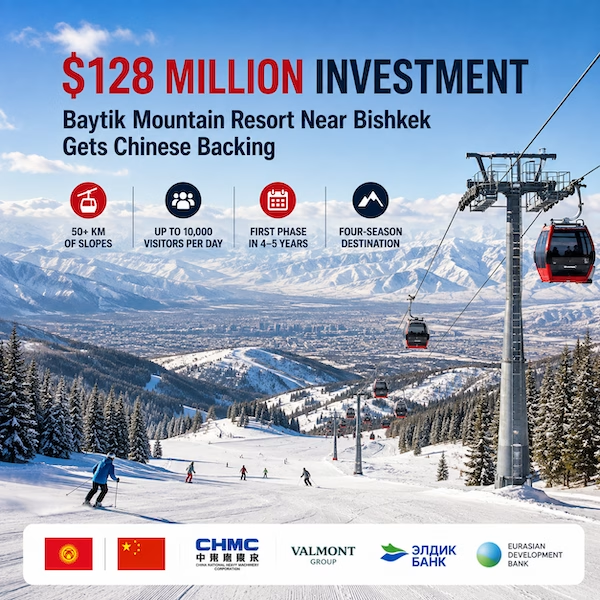
Imagine landing at an international airport and standing on a ski slope within an hour. Kyrgyzstan is betting exactly that. On August 27, 2026, at a Kyrgyz-Chinese investment forum in Bishkek, a public-private partnership agreement gave Baytik Mountain Resort fresh Chinese backing, one of two simultaneous mega-resort ski projects the country is pursuing as a deliberate national tourism strategy.
The money behind it is serious, and it comes from an unusual direction. China National Heavy Machinery Corporation (CHMC) will take part in both construction and financing.
Welmont Group and state-owned Eldik Bank join the funding, alongside an earlier trilateral memorandum with the Eurasian Development Bank. Total project value now stands at $127.9 million, revised upward from earlier estimates of about $101 million.
That matters beyond the slopes. Chinese companies in Kyrgyzstan have historically focused on transport and energy, so a major Chinese contractor entering tourism infrastructure signals a sector shift. The Baytik deal was part of the same August 2026 forum that signed over $300 million in bilateral agreements spanning energy, water, customs, and oil and gas.
That is the bigger story: Chinese capital is now ready to build leisure, not just roads and power lines.
Two Resorts, Two Very Different Roles
Baytik is distinct from Kyrgyzstan’s other major project, the €1.2 billion Ala-Too Resort near Issyk-Kul. Baytik sits just 35 km from Bishkek and the international airport, built for short-stay, accessible ski trips.
Ala-Too aims at a different scale: a large international tourism cluster with 260 km of planned slopes, targeting 2 million visitors annually once fully built out. Karakol, Kyrgyzstan’s best-known existing ski destination, sits roughly 400 km from the capital. Together, the two new resorts are two different answers to one question: how to turn mountains into year-round income.
The numbers at Baytik itself are sizeable. Plans call for 50+ km of slopes, 22 lifts, and capacity for up to 10,000 skiers per day, with the resort operating as a four-season destination. The first phase of infrastructure is expected within four to five years, consistent with a 2030 target opening.
This is not virgin ground. Kashka-Suu village, where Baytik is planned, has hosted ski activity since the Soviet era, with its first ski club established in 1976. The gorge already hosts small ski areas, so the project upgrades existing recreational infrastructure rather than starting from zero.
Employment projections include 1,500 construction jobs and approximately 800 permanent positions, with at least 80% of permanent roles reserved for Kyrgyz citizens.
Why Winter, and Why Now
The investment follows real momentum. Foreign visitors spent almost $1.1 billion in Kyrgyzstan in 2025, up from $1.02 billion in 2024, and tourism’s share of GDP reached 3.8%. Yet much of that demand still arrives in the warm months, which is why mountain resorts are explicitly aimed at reducing dependence on the summer season and Issyk-Kul.
If Baytik hits its 2030 date, you could land in Bishkek and ski the same afternoon. Building two mega-resorts at once is ambitious, but the logic is simple: make winter earn as much as summer. For travelers, a new ski destination sits within an hour of the runway. For Kyrgyzstan, the tourism economy no longer sleeps when the snow falls.