
Forgotten by most skiers, Kyrgyzstan is turning rapid growth, state-backed mega-projects, and wild Tien Shan terrain into Central Asia’s most surprising winter destination.
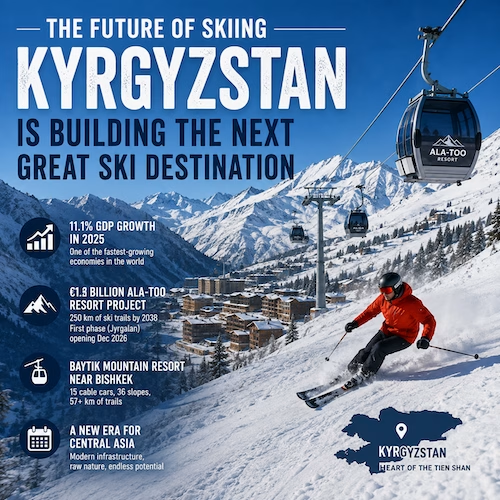
Most skiers planning a trip think of the Alps, the Rockies, or maybe Japan, but they rarely think of Kyrgyzstan. That is a mistake if you want empty slopes, big mountains, and a destination still shaping its future. Kyrgyzstan is a landlocked country in Central Asia that most skiers have never considered for a winter trip.
It borders China, Kazakhstan, Uzbekistan, and Tajikistan. It sits in the heart of the Tien Shan mountain range, where dramatic alpine terrain rivals better-known destinations.
Despite its stunning geography, Kyrgyzstan remains underdeveloped. Much of the country’s road network is unpaved, and in many cities some of the streets still lack asphalt. The capital Bishkek, along with regional hubs like Osh and Karakol, still struggles with basic infrastructure that Western travelers take for granted.
That roughness is part of the appeal for adventurous skiers, but it also explains why the country has stayed off the mainstream winter map. For now, you are more likely to find raw landscapes than turnkey resort towns. But the ground is shifting fast, and the numbers show the next decade could change how skiers see Central Asia.
A Fast-Growing Economy Is Funding the Mountains
Kyrgyzstan is currently one of the fastest-growing economies in the world. GDP surged by 11.1% in 2025, pushing the country’s economic output toward $23 billion, according to Astana Times reporting.
The Asian Development Bank forecasts continued economic expansion of 8.6% for Kyrgyzstan in 2026. That kind of momentum matters for a mountain country trying to build modern tourism from the ground up.
GDP per capita reached approximately $3,202 nominal and $10,024 in purchasing-power terms in 2026. Per-capita income growth hit 9.3% in 2025, per World Bank data.
The economic boom is translating into massive construction projects across the country. In Bishkek, the Royal Central Park development is reshaping the capital’s skyline with modern residential and commercial towers.
Around Lake Issyk-Kul, Kyrgyzstan’s premier natural attraction, developers are building new villas, hotels, and resorts. They aim to serve a growing stream of domestic and international tourists, not just winter visitors.
For a traveler, growth does not only mean cranes and spreadsheets. It can mean better roads, more hotels, and easier access to mountains that were once hard to reach.
Ala-Too Resort Is the €1.2 Billion Flagship
The flagship ski infrastructure project is Ala-Too Resort. This state-backed mountain tourism cluster is located in the Ak-Suu district of eastern Kyrgyzstan and spans 3,916 hectares of Tien Shan terrain. The estimated investment is 1.2 billion euros.
Construction began in August 2025. The project is planned in three phases. Phase 1 is Jyrgalan, opening December 2026 with 46 km of trails. Phase 2 is Ak-Bulak, and Phase 3 is Boz-Uchuk.
The first phase gives the project a clear near-term milestone. If Jyrgalan opens in December 2026, skiers will get their first taste of the resort before the full network is finished.
When fully completed by 2038, Ala-Too Resort is expected to offer approximately 250 km of ski trails. Those trails are planned to be served by six Doppelmayr cable car systems.
The resort is designed as a year-round destination. It aims to provide up to seven months of skiing annually, alongside summer hiking, mountain biking, and alpine activities.
For skiers seeking fresh terrain outside the crowded Alps or Rockies, Kyrgyzstan offers a genuine frontier destination. Modern resort infrastructure is being built from scratch in spectacular mountain settings.
Baytik Mountain Resort Adds an Olympic-Scale Bet Near Bishkek
Ala-Too is not the only project to watch. The Baytik Mountain Resort is taking shape near Bishkek with a $100 million investment. It is backed by a trilateral partnership involving the Kyrgyz Investment Agency, Vasta Discovery, and the Eurasian Development Bank.
The plan envisions 15 cable cars, 36 ski slopes covering more than 57 km, and four tourist villages. It also includes a competition-grade ski complex designed to meet international standards for Olympic and World Cup events.
Construction at Baytik Mountain Resort is slated to begin in 2026, with a target opening around 2028. That gives travelers a second future hub closer to the capital.
The combination of rapid economic growth, state-backed mega-projects, and still-affordable travel costs creates a narrow window. Early visitors can experience Central Asia’s emerging ski scene before the rest of the world catches on.
This is not a finished destination. It is a place to visit before the lifts and international attention arrive. Keep an eye on the progress of these resorts, we will report on the progress at skicentralasia.com.