
Preparatory work began at Shymbulak, Butakovskoye, and Kimasar on August 25, while the separate SuperSki project faces opposition over a planned access road affecting 3,105 trees, including 472 Red Book-listed specimens
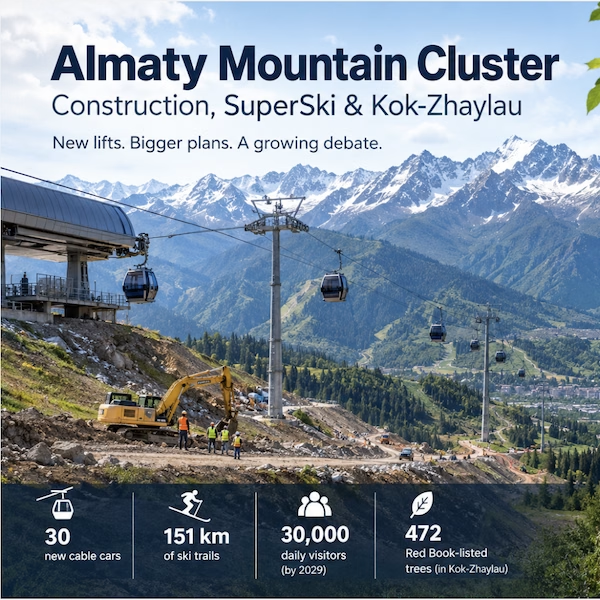
The Almaty Mountain Cluster has entered its practical implementation phase.
And an eco-activist has been jailed for 15 days after publishing audio recordings about protected trees allegedly discussed at an akimat meeting.
Both developments are part of a much bigger expansion of Almaty’s mountain-tourism infrastructure — but they involve two related, separate projects: the Almaty Mountain Cluster and the Almaty SuperSki resort.
The Mountain Cluster is being developed through 2029 and promises 30,000 daily visitors.
SuperSki, meanwhile, has become the center of a growing environmental dispute over development at Kok-Zhaylau, including a planned access road that could affect hundreds of Red Book-listed trees.
Construction Began August 25 at Three Sites
In April 2026, Prime Minister Olzhas Bektenov placed both the Almaty Mountain Cluster and Almaty SuperSki under special control, criticizing the slow pace of implementation.
Four months later, the Mountain Cluster moved into its practical implementation phase.
On August 25, Almaty authorities announced that preparatory work had begun at Shymbulak, Butakovskoye gorge and Kimasar gorge.
At Shymbulak, crews are preparing to build two new lifts: a four-seat chairlift and a drag lift. The stated goal is to increase capacity and distribute visitor flows more evenly.
In Butakovskoye gorge, engineering-geological surveys are underway.
A technological access road toward “Butakovka — 2000 m” is also being built to allow construction equipment to reach the site and provide access for engineering networks.
In Kimasar gorge, a construction site has been prepared for a future base station.
At the cluster’s sites, trees and other green plantations are being surveyed and marked.
Authorities say the inventory is intended to account for the existing landscape and minimize environmental impact during the design and construction process.
The comprehensive development plan for the Almaty Mountain Cluster through 2029 contains 73 measures across seven directions.
Its physical scale is substantial: the plan envisages 30 new cableways and 151 kilometers of ski trails, ultimately integrating Shymbulak and Oi-Qaragai into a much larger mountain-tourism system with Medeu as a key base and transport hub.
Daily capacity is expected to rise fivefold, from around 6,000 to 30,000 visitors.
Foreign tourist numbers are projected to increase from approximately 986,000 to 1.7 million annually.
Employment in tourism is projected to reach 101,800 jobs.
Shymbulak already receives more than one million visitors a year and has operated without using the state subsidy program available to certain mountain resorts, relying on its own revenue and private investment for operations and development.
The cluster is also being developed alongside preparations for the 2029 Asian Winter Games. Shymbulak and other existing Almaty sports facilities are being assessed as potential venues, although I found no official confirmation that the future Almaty SuperSki resort itself will host Asian Games events.
Kok-Zhaylau: An Arrest, Leaked Audio, and 472 Protected Trees
While construction is beginning elsewhere in the mountain cluster, the separate Almaty SuperSki project is facing an increasingly contentious environmental debate.
On August 29, police searched the home of eco-activist Aruna Ortayeva and took her to a police department. She was subsequently given 15 days of administrative arrest.
The arrest came after she published audio recordings allegedly made during an akimat meeting.
The recordings reportedly contain a discussion about trees affected by the planned development at Kok-Zhaylau.
According to reports about the audio, participants discussed approximately 2,010 trees, including around 700 Red Book-listed trees.
Those figures came from the leaked conversation, however, and should not be treated as the final official tree inventory.
A later report on September 2 cited an official inventory giving a different picture.
According to Total.kz, the planned 6.02-kilometer access road to the SuperSki development intersects with approximately 3,105 trees, including 472 Red Book-listed Sievers apple and common apricot trees.
The two sets of figures therefore refer to different counts and stages of the project rather than establishing that 700 protected trees will definitely be removed.
Importantly, the government had not yet authorized the removal of the protected trees at the time of those reports.
The issue has nevertheless become one of the most controversial parts of the SuperSki project.
On September 3, activists and lawyers held a press conference and announced plans to challenge the environmental public hearings in court.
Rights advocates also argued that the authorities’ handling of the leaked recording suggested that officials were not simply dismissing it as fabricated.
The dispute now centers on whether the planned infrastructure can proceed without unacceptable damage to the unique ecosystems and protected trees of Kok-Zhaylau.
Scientists, Officials and Activists Disagree
The environmental argument is far from settled.
Ecology Minister Yerlan Nysanbayev has said that studies conducted with scientists and environmental specialists concluded that Almaty SuperSki would not have a negative impact on the environment.
Activists strongly dispute that conclusion.
Opponents of the project have also cited the earlier work of veteran Medeu construction engineer Boris Yaglinsky, arguing that expert surveys involving European specialists did not identify Kok-Zhaylau as the preferred location for a major ski resort.
The disagreement therefore goes beyond the question of individual trees.
It is a debate over whether a large new ski resort should be built in this particular mountain environment at all — and whether the economic benefits justify the ecological costs.
What Comes Next: Public Hearings, 526 Billion Tenge and Private Investment
The wider Mountain Cluster is backed by a comprehensive plan running through 2029.
The plan has a total estimated cost of about 526 billion tenge.
But the money is not all coming from private investors.
Approximately 287 billion tenge is assigned to republican and local public budgets, while about 239 billion tenge is expected from extra-budgetary and private sources.
Almaty SuperSki has a different financing structure. Officials have said that Baiterek is financing core infrastructure, while hotels and other commercial facilities are expected to attract private investment.
At the same time, opposition to development at Kok-Zhaylau is continuing.
Activists are also pushing for stronger legal protection for mountain ecosystems and greater public involvement in decisions affecting the Almaty mountains.
For skiers and tourists, the immediate changes will be visible in construction sites, new lifts and eventually a much larger interconnected ski area.
But the most important decisions about Kok-Zhaylau will happen away from the slopes — through environmental assessments, public hearings, court challenges and government approvals.
The question now is whether Almaty’s promised mountain expansion can move forward while preserving the landscapes and protected trees that make these mountains valuable in the first place.