
Kazhydromet’s October 16 seasonal outlook projects above-normal temperatures across most regions, a wetter February, and an ice-crust risk that could reshape snow conditions from Shymbulak to Chimgan.
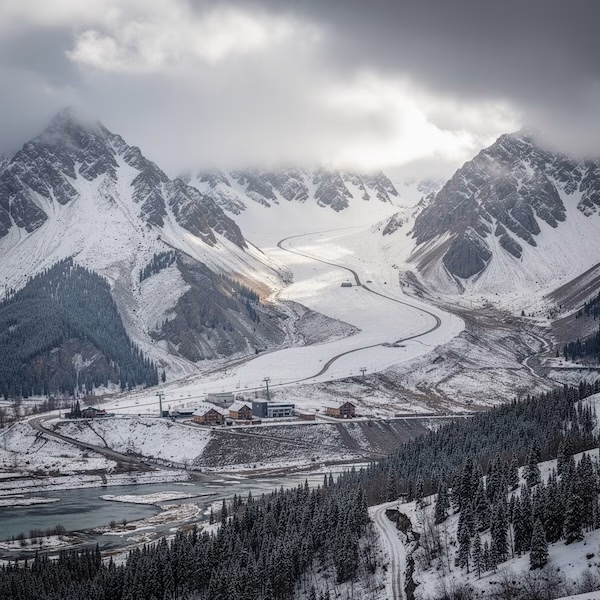
Kazakhstan’s coming winter is shaping up to be warmer than the climate record says it should be.
On October 16, 2026, Kazhydromet, the country’s national hydrometeorological service, published its seasonal winter forecast. The message is direct: expect a mild winter, with temperatures above the long-term climatic norm across most regions.
If you ski, travel, farm, or simply build your winter plans around historical averages, that one sentence changes quite a bit.
Month by Month: December Through February
December opens the season on the warm side. Average air temperatures are expected to run 2 degrees Celsius above the climatic norm nationwide.
Precipitation should stay near normal across most of Kazakhstan, with above-normal levels in parts of the north, the northeast, and the east. There is one clear outlier: the Kyzylorda Region is forecast to receive less precipitation than usual.
January keeps the pattern going. Temperatures should come in 1 to 2 degrees Celsius above the climatic norm across most of the country, while the northwest is forecast to see near-normal conditions.
January precipitation is likely to remain near normal overall, with higher levels in parts of western Kazakhstan and below-normal amounts in areas of the south and southeast.
February is the warmest and wettest month in the outlook. Forecasters expect temperatures 1 to 3 degrees Celsius above normal across most of Kazakhstan.
Precipitation may exceed the climatic norm across much of the country. Several western and southern areas should still see near-normal levels, and parts of the southwest may receive less than usual.
A mild winter is not a calm one, though. Forecasters warn of significant temperature fluctuations throughout the season, swings that can melt and refreeze the snowpack and contribute to the formation of an ice crust within the snow cover.
Blizzards, strong winds, fog, and icy conditions remain possible in various regions. An above-normal seasonal average still allows for sharply below-normal weeks.
Super El Niño Is Driving the Mild Outlook
This winter’s forecast aligns with the ongoing Super El Niño of 2026-2027, which has reached record strength according to the World Meteorological Organization and climate monitoring agencies.
El Niño typically redistributes global precipitation and temperature patterns. In Central Asian continental climate regimes, that shift tends to bring warmer and wetter winter conditions.
Kazhydromet has addressed the connection publicly. Multiple outlets, including TengriNews and open.kg, have reported the agency acknowledging links between Kazakhstan’s climate anomalies and El Niño, with the national weather service responding to public questions about how the current event connects to local weather patterns.
What It Means for Uzbekistan and Kyrgyzstan
Central Asian meteorology operates across shared continental climate systems. Large-scale drivers like El Niño affect Kazakhstan, Uzbekistan, and Kyrgyzstan through similar atmospheric circulation shifts.
That makes comparable seasonal outcomes likely across all three countries, even when national forecasts are issued separately.
Kyrgyz outlet 24.KG reported that meteorologists expect significant above-normal precipitation across Central Asia during 2026-2027. That backs a broader regional wet-tilted outlook extending well beyond Kazakhstan’s borders.
One gap is worth noting: no equivalent Uzbekistan or Kyrgyzstan national met service forecasts had been published in English-language media by late October 2026. The same continental-scale climate forcing still applies across the region, so skiers heading to other Central Asian ski resorts like Amirsoy, Karakol, or Jyrgalan should factor in similar mild-and-wet winter expectations.
How to Plan a Ski Trip Around a Warm Winter
For skiers, above-normal temperatures mean softer snow conditions and potentially shorter optimal early-season ski windows. December and January may not hold the cold, dry snow these resorts usually deliver.
February is the counterweight. Increased February precipitation could deliver a deeper snowpack for late-season skiing at resorts like Shymbulak, Jyrgalan, and Ala-Too.
The trip-planning implication is practical. Travellers booking Kazakhstan ski trips for December through January should prepare for milder conditions than historical averages.
Gear choice and timing adjustments matter more this season. That means packing for warmer snow, watching storm cycles instead of a fixed calendar, and staying flexible enough to push a trip toward February, when the snowpack is most likely to be at its deepest.
The season is not short of snow. It is short of cold, and that is the detail worth planning around.