
Kyrgyzstan’s president has put a common tourist visa covering Central Asia and Azerbaijan back on the table. For skiers, that would mean three mountain ranges and one permit.
Planning a ski trip across this region currently means juggling three sets of entry rules. Kyrgyzstan lets most Western passport holders in for 60 days without a visa. Kazakhstan gives you 30. Azerbaijan asks for an e-Visa or an advance arrangement, depending on your nationality. A proposal made on the Caspian coast in October 2026 would collapse all of that into a single document.
What Japarov Proposed in Avaza
On October 8, 2026, at the Consultative Meeting of the Heads of State of Central Asia, held with Azerbaijan’s participation in the Avaza zone of Turkmenbashi, Kyrgyz President Sadyr Japarov proposed a common tourist visa for Central Asia plus Azerbaijan. He called on the region’s foreign ministries to prepare specific proposals.
That last instruction matters. Asking foreign ministries for concrete text is what turns a summit statement into a working process, or at least into the beginning of one.
Japarov built his case on complementary assets rather than competition. Kyrgyzstan and Kazakhstan supply the mountain terrain and winter sports. Azerbaijan adds its own mountain infrastructure plus Caspian coastal resorts for post-ski recovery. Uzbekistan brings Silk Road cultural heritage, and also slopes if the traveler wants to ski even more.
The choice of venue sent its own signal. Ashgabat maintains restrictive visa policies and did not publicly commit to joining the scheme. Turkmenistan’s willingness to host the meeting where the idea was advanced suggests that regional tourism integration is gaining diplomatic currency even among the region’s more isolated capitals.
How Azerbaijan Got Into the Room
Azerbaijan’s inclusion is the new element. The previous iteration of the proposal was raised at the July 31, 2026 summit in Cholpon-Ata, on the shore of Lake Issyk-Kul. That version secured support only from Kazakhstan and Uzbekistan. Azerbaijan becomes the first non-Central Asian state invited into the scheme.
Part of the groundwork was laid a month later. The 6th World Nomad Games, held across Issyk-Kul in August and September 2026, drew leaders from nine countries, including Azerbaijan, Kazakhstan and Uzbekistan. Multi-country sporting and cultural events are already routine here, which makes a shared permit feel less like a leap.
Azerbaijan also arrived with winter-sports standing. In May 2025 it was named the first-ever Global Destination Partner of the International Ski and Snowboard Federation (FIS). The agreement carries title sponsorship rights for the Moguls, Aerials, Ski Cross and Snowboard Cross World Cups through the 2029–30 season.
The terrain behind that deal is concrete. Shahdag Mountain Resort sits in the Greater Caucasus, above 2,300 metres, with FIS-certified slopes, and it is already open and operating.
Three Mountain Ranges on One Itinerary
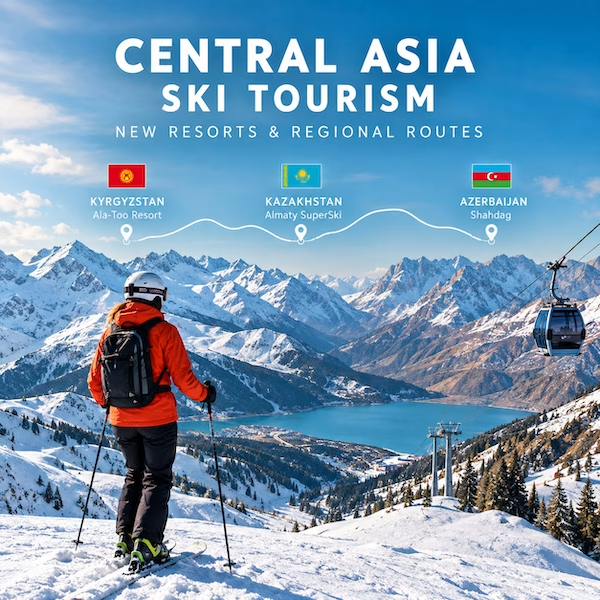
A unified visa would create a contiguous mountain-tourism corridor, running from Kyrgyzstan’s Ala-Too Resort through Kazakhstan’s Almaty SuperSki cluster to Azerbaijan’s Shahdag.
Ala-Too opens in December 2026, with 250 km of planned slopes and lifts built by Austria’s Doppelmayr. The first two cableways, B1 at 1,727 m and B2 at 2,296 m, are complete. Thirty-nine land plots have been sold for hotels and support facilities, which tells you private money expects guests.
Kazakhstan’s Almaty SuperSki broke ground in July 2026, built around a merger of Shymbulak and Oi-Qaragai. POMA is installing 11 ropeways, including 3S gondolas, within a plan that reaches 58 lifts and a visitor capacity above 30,000.
Shahdag is the finished end of the corridor. It holds FIS-certified terrain right now, so it can absorb travellers while the other two are still building.
All three countries are investing heavily in ski infrastructure at the same time. The geography holds together better than you might expect. Bishkek, the gateway to Ala-Too, sits roughly 240 km by road from Almaty, the gateway to Shymbulak. From Almaty to Baku, the gateway to Shahdag, is about 2,200 km by air, or a three-hour flight.
The three resorts also sit in completely different mountain systems: the Tian Shan, the Trans-Ili Alatau and the Greater Caucasus. One trip would cover three distinct snow climates, not three variations on the same range.
The Rules That Apply to Your Trip Right Now
The paperwork problem this proposal addresses is real. Under current rules, a skier sampling all three ranges has to clear three separate entry regimes in a single holiday. A unified permit would remove that barrier entirely.
Nothing has been published yet, though. There is no timeline, no fee structure and no application process. This remains a diplomatic initiative.
So do not book the 2026–27 season on the assumption that a single visa will be live. Existing national visa rules remain the only guaranteed entry path, and they are what you should plan around today.
If you travel independently or run trips for others, there is one metric worth watching. Look for a pilot programme or a working-group communiqué before the 2027–28 winter season. That is the signal that foreign ministries have actually produced the specific proposals Japarov asked for.
Until concrete treaty text exists, the corridor stays aspirational. The mountains themselves are not. Lifts are rising in Kyrgyzstan, Kazakhstan and Uzbekistan, and Shahdag already has certified terrain underfoot. The snow is arriving faster than the paperwork.