
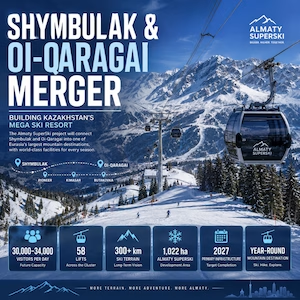
The Almaty SuperSki project will connect Shymbulak and Oi-Qaragai into one of Eurasia’s largest mountain destinations, with up to 58 lifts, 300 km of ski terrain, and capacity for more than 30,000 visitors per day.
What if your next ski trip didn’t involve hour-long lift lines or sold-out weekends?
On July 21, 2026, Kazakhstan dropped news that will reshape Central Asian tourism. Shymbulak and Oi-Qaragai, the country’s two flagship ski resorts, are merging into one unified mountain complex. Seven media outlets, 24.kz, Kursiv Media, 365info.kz, inalmaty.kz, Noks.kz, Zakon.kz, and BAQ.KZ, broke the story simultaneously.
That coordination signals something serious. The government isn’t tinkering around the edges. They’re building something massive.
From 6,000 to 34,000: The Numbers That Matter
Right now, the Almaty mountain cluster caps out at roughly 6,000 visitors per day. That’s it. Six thousand people spread across Kazakhstan’s premier winter destinations.
Here’s where it gets interesting. Once fully built out, the merged Shymbulak-Oi-Qaragai complex will handle between 30,000 and 34,000 visitors daily. That’s approximately five times the current capacity. Five times more room for you to carve fresh tracks without bumping elbows.
The infrastructure tells the same story. Currently, the central zone operates 16 lifts. The new plan calls for 58 over the whole cluster. We’re talking about roughly 30 new cable cars weaving across the Almaty mountain cluster, connecting terrain that previously required separate trips, separate tickets, separate headaches.
The Master Plan Behind the Merger
This isn’t a standalone project. The merger serves as the core component of something larger: the Almaty SuperSki master plan.
On September 25, 2025, the Board of Directors of Kazakh Tourism Development approved the plan under Prime Minister Olzhas Bektenov. They didn’t go with just any consultants. They partnered with Pas Grau Internacional, an Andorra-based firm that has designed over 60 resorts worldwide. PGI built Grandvalira in Andorra. They designed Bovec in Slovenia. Now they’re bringing that expertise to Kazakhstan.
The central zone of Almaty SuperSki explicitly encompasses both Shymbulak and Oi-Qaragai alongside Pioneer, Kimasar, and Butakovka. Think of it as creating a connected ecosystem rather than isolated destinations.
The timeline is aggressive. According to a trend.az report from April 2026, the target completion date for Almaty SuperSki infrastructure is 2027. In April 2026, Prime Minister Bektenov personally instructed officials to accelerate implementation of both the Almaty mountain cluster and Almaty SuperSki projects. They want this built. They want it built now.
What 300 Kilometers of Ski Slopes Looks Like
Let’s get specific about what you’re getting.
Almaty SuperSki alone covers 1,022 hectares. It includes 17 ski lifts, more than 60 kilometers of ski slopes across varying difficulty levels, and a 20-hectare mountain village. The broader cluster concept expands this vision significantly. Up to 30 cable cars. Nearly 151 kilometers of ski trails within the immediate cluster. The total ski slope network across the entire system is projected to reach between 300 and 700 kilometers.
That’s not a ski resort. That’s a ski civilization.
But here’s the thing. The government isn’t building this for three months of winter revenue. They’re positioning it as a year-round tourism ecosystem. Plans include extensive hiking routes, dedicated cycling and mountain biking infrastructure, modern visitor centers, and an integrated mountain safety system. A modern cable car linking the Medeu base station with the resort sector will reduce dependency on road access. Whether you ski in January or mountain bike in July, the infrastructure supports you.
The Investment and the Track Record
Money talks. In March 2026, Kursiv Media reported that the Kazakh government allocated 172 billion tenge specifically for the unification of mountain resorts in Almaty.
This funding follows earlier signals. Back in September 2024, Kursiv Media reported on a potential $400 million cable car project to connect the two resorts. In May 2024, Kazakhstan Pravda covered domestic investors’ intentions to link the resorts by cableway. The vision has been building for years. The July 2026 announcement makes it official.
Shymbulak brings serious credentials to this merger. It already hosts regular FIS Freestyle World Cup events in moguls and aerials. It hosted the FIS Freestyle World Championships in 2021 and the FIS Freestyle Junior World Championships in 2025. Its moguls course, known as Yuka G, begins at approximately 2,750 meters altitude. This isn’t a novice hill getting a facelift. It’s an Olympic-caliber venue expanding its territory.
Built Different: Environment and Community
The project faces the same scrutiny any major mountain development encounters. Officials emphasize environmental compliance, stating that construction must adhere to both national and international environmental laws. The master plan incorporates satellite data for climate and terrain analysis, green standards, and modern ski equipment production technologies.
Implementation requires coordinating public and private investments, establishing governance structures for the Almaty Mountain Cluster, and ensuring local communities benefit through job creation, infrastructure development, and sustainable growth.
Your Move
The 2027 completion date is approaching fast. When those 58 lifts start turning and 30,000+ daily visitors flow through a connected network spanning 300+ kilometers of terrain, Kazakhstan’s place on the global ski map changes permanently.
You can wait until 2027 to discover what this looks like. Or you can start paying attention now. The largest ski complex in Central Asian history isn’t coming. It’s already under construction.